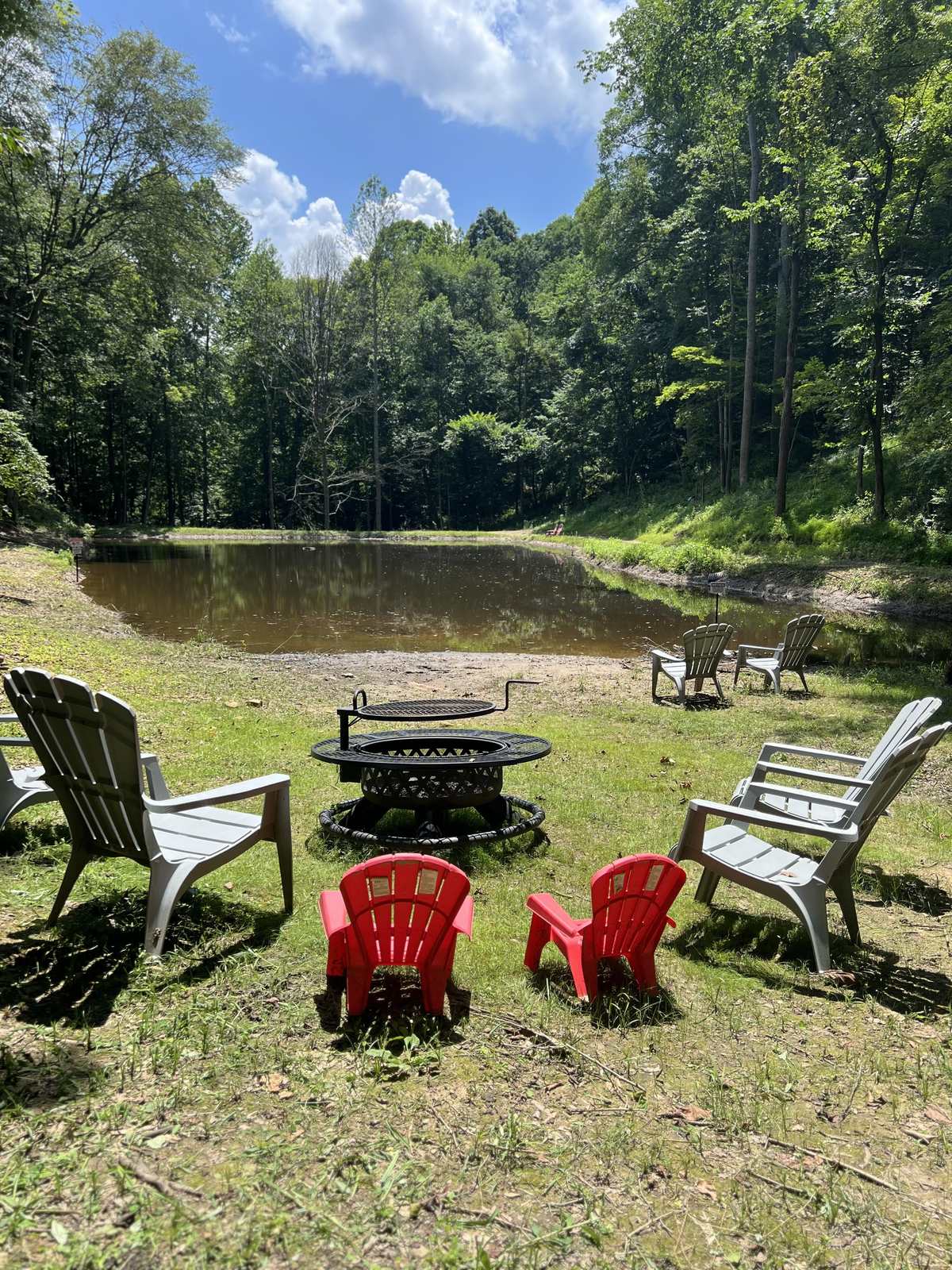
Somebody's first fish usually happens right here — somewhere between the dragonflies lifting off the surface and the second cup of coffee going cold in your hand. If you've been searching for a hocking hills cabin with fishing pond and wondering whether it's the real deal or just a decorative feature that photographs well, here's the honest picture.
The stocked pond at Bigfoot Bungalow is the kind of thing that quietly becomes the best part of a trip you originally planned around the gorges. Kids wade up to the edge with borrowed patience they didn't know they had. Grandparents find a reason to sit still for an hour. Even the guests who swore they were here to hike end up at the water at least once.
This guide covers everything that actually matters: what's in the pond, what gear to pack, what the catch-and-release rules mean in practice, whether you need a fishing license, and what the fishing looks like across the seasons. No fluff — just the practical stuff so you can show up ready.
Planning a Hocking Hills trip? Find the cabin that fits your group.
See Our CabinsWatch: a quick tour of all three cabins and the Hocking Hills area.
What Makes This Pond Different From Public Water Fishing?
The short answer: no crowds, no boat ramps, no strangers. The pond sits on Bigfoot Bungalow's 50 private acres, and when you're out there, it's yours.
Public lake fishing in Ohio — Burr Oak State Park, Lake Logan, Paint Creek — is genuinely good, but it comes with a parking lot, other anglers working the same bank, and the background noise of a public space. The Bigfoot pond is the opposite. You walk out when the mood strikes (sunrise is a particular treat — the surface is still and the light comes through the tree line at a low angle), fish for as long as you want, and head back to the cabin when you're done.
It's also the kind of water where a first-timer can actually succeed. Stocked ponds are forgiving. The fish are there; you just have to show up with the right rig and a little patience — which, honestly, the setting supplies for you.
A few things to know before you go: - Catch-and-release only. Fish go back in. Every one. - Bring your own gear. Rod, reel, tackle, bait — pack it yourself. The cabin doesn't supply fishing equipment. - No swimming in the pond. It's for fishing. - No watercraft. Bank fishing only. - Anyone under 18 must be supervised at the pond.
Do You Need a Fishing License to Fish the Bigfoot Pond?
This is the most-searched practical question, and the answer has a nuance worth understanding.
Ohio generally does not require a fishing license to fish a self-contained privately owned pond — specifically one where fish do not migrate to or from public waters. A privately stocked farm pond that holds its own fish and has no inlet or outlet connecting it to a public waterway typically falls under an Ohio Division of Wildlife exemption from the standard license requirement. That's the category a stocked private cabin pond like this one is generally understood to occupy.
That said:
- Rules can change, and this post isn't legal advice — it's a general description of how Ohio's exemption has historically worked for private stocked ponds.
- If you're fishing anywhere else on the trip — a state park lake, a public stream, any water that isn't this private pond — you need a valid Ohio fishing license.
- Taking frogs or turtles requires a license even on private property. This is a separate Ohio rule worth knowing.
- Always confirm current rules at ohiodnr.gov before your trip, and message the host directly if you want to ask about the specific pond status.
| Situation | License likely needed? |
|---|---|
| Fishing the Bigfoot Bungalow private stocked pond | Generally no — private pond exemption typically applies; confirm with host + Ohio DNR |
| Anglers under 16 fishing anywhere in Ohio | No — statewide age exemption |
| Fishing a public lake or stream during your trip | Yes — Ohio fishing license required |
| Taking frogs or turtles (private or public water) | Yes — separate Ohio license required |
The table above describes the general position under Ohio's private-pond rules as they've historically applied; it is not legal advice. Verify current rules at ohiodnr.gov and with the host before your trip.
What's in the Water? What Can You Expect to Catch?
The pond is stocked — meaning the fish are put there intentionally, not just whatever wandered in from a nearby creek. Stocked ponds in Ohio typically hold species like bass and bluegill, which are the workhorses of Midwestern private-pond fishing: active, responsive to basic rigs, and genuinely fun on light tackle.
Bluegill are the friend of every kid who has ever fished. They hit readily, they fight above their weight class on a light rod, and they're the fish most likely to make a first-timer's afternoon. Bass take a little more finesse — working a soft plastic along the bank edge or a small spinner through the shallows — but they're there.
Watch for dragonflies. Wherever dragonflies are working the surface, fish are usually active underneath.
What Gear Should You Bring?
You will need to pack your own. Here's a quick-reference checklist:
Rods and Reels
A light or ultralight spinning combo is ideal for both bluegill and smaller bass. If you're fishing with kids, a simple push-button spincast reel is nearly foolproof. One rod per person is plenty; bring a backup if you have one.
Terminal Tackle and Bait
- Hook sizes: #6 or #8 for panfish, #2 or #4 for bass
- Bobber rigs: the classic, and it works — great for kids and still-water pond fishing
- Soft plastics: curly-tail grubs, small creature baits, or a simple plastic worm for bass
- Live/natural bait: red worms and nightcrawlers are reliable for bluegill; check Ohio regulations for any bait-related restrictions if importing live bait across state lines
- Small spinners and inline lures: good for working the banks early morning
- Extra line, split shot, extra hooks — always
Quick Gear Reference Table
| Angler | Recommended rig | Bait | License note |
|---|---|---|---|
| Kids (under 16) | Light spincast, #6–8 hook, bobber | Worms / nightcrawlers | No license needed statewide |
| Teens / adults | Light spinning combo | Worms, soft plastics, small spinners | Generally not required for this private pond — confirm |
| Bass-focused angler | Light-medium spinning, #2–4 hook | Soft plastics, small inline lures | Generally not required for this private pond — confirm |
See the license section above for the full private-pond rule explanation.
When Is the Best Time to Fish the Pond?
The short answer: early morning, any season — but each season brings something different.
Spring (April–May): High Activity
Spring is when stocked ponds come alive. Fish that have been sluggish through cold water warm up fast, feeding aggressively as temperatures climb. Bass move into shallower water to spawn, making them accessible from the bank. Bluegill are active at almost any hour. If you're visiting in April or May and want the best odds, the pond deserves a morning.
Summer (June–August): Early or Late
Summer fishing rewards the early riser. Once the sun is fully up and the day heats up, fish drop to deeper, cooler water and go quiet. Show up at first light — the surface is still, the mist is lifting, and the fish are actively feeding. An hour before breakfast is often the best hour. Midday, skip the pond and do the gorges; come back to the water in the last hour of daylight if you're up for it.
This is also peak dragonfly season. The surface buzzes with them in July and early August, which is great for the atmosphere and a reliable indicator of where the fish are active underneath.
Fall (September–October): Quiet and Scenic
Fall fishing on a private pond is underrated. Fish are feeding again before winter, the crowds on the trails thin out, and the color around the pond edges is the kind of thing you frame a memory around. Early October morning at the Bigfoot pond, with the maples reflecting off still water, is a scene most people don't expect to find at a cabin rental.
Winter (November–March): Slow but Possible
Cold-water fishing is slow. Fish are sluggish, feeding infrequently, and down deep. It's not the trip you plan around the pond, but on a mild winter afternoon, casting a few times can be a surprisingly meditative way to spend an hour between fireside sessions.
Fishing With Kids: The First-Fish Experience
There's a reason "kids' first fish" keeps coming up in conversation about the Bigfoot pond. Stocked private water is exactly the right environment for it — the fish are there in decent numbers, the bank is accessible, there's no current to fight, and nobody else is competing for the same spot.
A few things that make it work:
- Keep the rig simple. Bobber, hook, worm. Complicated tackle is the enemy of a kid's patience.
- Start early. Summer mornings before the heat sets in keep the fish — and the kids — more cooperative.
- Set low expectations, let the reality beat them. Tell them you're going to try; let catching something be the bonus. In practice, the bluegill usually cooperate.
- Have something to take a picture with. The fish goes back in, but the picture stays forever. A kid holding their first fish at the edge of a still pond on a summer morning — that's the moment.
For families planning a trip with a mix of ages, the pond pairs naturally with everything else Bigfoot offers. The farm animals are a short walk away (the goats have opinions about being ignored). The private trails give older kids and adults a place to roam. The firepit reassembles everyone at the end of the day. The pond is one piece of that, but it's a genuinely good piece.
If you're planning a full family trip to the area, the hidden gems of Hocking Hills guide is worth reading for spots near the cabin that most visitors drive right past, and the Hocking Hills with kids guide covers the full picture of what works — and what to skip — when you've got young ones in tow.
Pond Rules: The Short Version
- Catch-and-release only — all fish go back
- No swimming in the pond
- No watercraft of any kind
- Guests under 18 must be supervised at all times
- Bring your own gear — nothing is provided
- Fishing license: private-pond exemption generally applies; verify at ohiodnr.gov and with the host
Getting to Bigfoot Bungalow
Bigfoot Bungalow sits at 9016 Voris Rd, Logan, OH — 50 private acres of woods, trails, and the pond.
If you're also planning to hit the gorge trails while you're in the area, the main Hocking Hills sites are a short drive:
- Old Man's Cave, Ash Cave, Cedar Falls, Conkle's Hollow, Rock House: Bigfoot: ~19–30 min · Haven/Harden: ~18–24 min
- Logan (restaurants, Kroger/Walmart): Bigfoot: ~12–15 min · Haven/Harden: ~5–10 min
The pond is on-property at Bigfoot — no drive required. Walk out the back, past the animal area, and you're there.
Bigfoot Bungalow is the only property in the JHC lineup with the fishing pond, the 50 private acres, and the farm animals — so if this is the kind of trip you're picturing, that's the cabin. And if you're booking direct rather than through a third-party platform, you'll likely keep more money in your pocket for gear, bait, and a good dinner in Logan on the way out. Book direct and save up to 15% vs Airbnb and VRBO
Choose Your Basecamp

Bigfoot Bungalow
Fifty private acres, farm animals, a stocked fishing pond, and private trails — with room for up to 16. Your own slice of Hocking Hills.
Book Bigfoot Bungalow
Hillside Haven
In-town Logan ease with single-level, no-step entry, a private hot tub, and a covered gazebo. Restaurants and groceries minutes away.
Book Hillside Haven
Harden Hideaway
A whole-house, three-bedroom retreat next door to Haven in town — with in-unit laundry, a sunroom workspace, and a five-person hot-tub deck. An easy in-town basecamp for a group.
Book Harden HideawayFrequently Asked Questions
Do I need a fishing license to fish the Bigfoot Bungalow pond?
Ohio generally does not require a fishing license for a self-contained privately owned stocked pond where fish don't move to or from public waters — which is the typical classification for a private cabin pond like this one. Anglers under 16 don't need a license anywhere in Ohio. That said, rules can change, and if you're fishing public water anywhere else on your trip, you will need a license. Check current rules at ohiodnr.gov and confirm with the host before you arrive.
Can I keep the fish I catch?
No — it's catch-and-release only. Every fish goes back in. The pond is stocked to stay healthy for all guests, and keeping fish would quickly deplete it. Catch the fish, take the photo, release it, repeat.
What fish are in the pond?
The pond is stocked. Private stocked ponds in Ohio commonly hold bass and bluegill. Bluegill are the most reliable for a quick first-fish experience; bass are there for anglers who want to work a little harder.
Can kids fish without an adult present?
No. Anyone under 18 must be supervised at the pond at all times. This is a firm rule, not a suggestion.
Is the Bigfoot pond good in summer, or should I plan a different season?
Summer fishing is best in the early morning before the heat settles in. Fish are most active in the first hour after sunrise — the water is still, the air is cool, and the pond is at its most alive. If you sleep in and wander out at noon in July, you'll have a beautiful view and probably not much action. Spring (April–May) and fall (September–October) are both excellent windows if you have flexibility.